
What Determines If You Need a Co-Signer for a Car?
1. Introduction: Why Some Car Loans Require a Cosigner
Buying a car is often one of the largest purchases people make outside of a home. Because vehicles are expensive and financing usually spans several years, lenders carefully evaluate how likely it is that a borrower will repay the loan. That is where a cosigner sometimes enters the picture.
A cosigner is a second person who agrees to take legal responsibility for the loan if the primary borrower cannot make the payments. In simple terms, the cosigner acts as a financial safety net for the lender. If the borrower falls behind or defaults, the cosigner becomes responsible for the remaining balance.
Whether you need a cosigner depends largely on how risky your application appears to the lender. Auto finance companies and banks look at multiple aspects of your financial profile before deciding if you qualify for a car loan on your own.
Some of the most important factors lenders analyze include:
Credit score and credit history – how reliably you’ve handled borrowed money in the past
Income and employment stability – whether you earn enough and have consistent income to make the payments
Debt-to-income ratio (DTI) – how much of your income is already committed to other debts
Credit history length – how long you’ve had credit accounts open
Loan size and vehicle risk – the amount you want to borrow and the type of vehicle being financed
If these factors suggest a higher level of risk, lenders may ask for a cosigner to strengthen the application.
If you're unsure how your credit score affects auto financing, you can also read our guide:
What Credit Score Do You Need for a $30,000 Car Loan in Canada?
Understanding how lenders evaluate these elements helps explain exactly why some borrowers are approved on their own while others are asked to bring in a cosigner.
2. The Core Reason Lenders Ask for a Cosigner
At its core, the reason lenders request a cosigner is simple: your application by itself doesn’t quite meet their approval standards.
Auto lenders evaluate every loan based on risk. If they believe the borrower may struggle to make payments, they look for ways to reduce that risk. One of the most common solutions is adding a cosigner with a stronger financial profile.
A qualified cosigner gives the lender reassurance because there is now another person legally responsible for the debt. If the primary borrower cannot pay, the cosigner must step in.
Several common factors can trigger a lender to ask for a cosigner.
2.1 Low or Poor Credit Score
Your credit score is one of the first indicators lenders use to measure financial reliability. It reflects how consistently you’ve paid previous loans, credit cards, and other debts.
Borrowers with lower scores are statistically more likely to miss payments or default. Because of this, lenders categorize many applicants with scores below roughly 660 as part of the subprime lending market.
Subprime borrowers can still get approved for auto financing, but lenders may require additional security. A cosigner with stronger credit helps reduce the lender’s risk and can make the difference between approval and rejection.
2.2 No Credit History
Sometimes the issue isn’t bad credit — it’s no credit at all.
Students, young buyers, and newcomers to Canada often fall into this category. Without any credit accounts or payment history, lenders simply don’t have enough information to evaluate how reliable the borrower will be.
From a lender’s perspective, no credit data creates uncertainty, and uncertainty equals risk. Adding a cosigner with an established credit history helps lenders feel confident approving the loan.
2.3 Insufficient or Unstable Income
Even if your credit score is acceptable, lenders still need to see that you earn enough income to afford the car payment.
If your income is too low relative to the loan amount, approval becomes less likely. Lenders also examine how stable that income is. For example:
Temporary employment
Inconsistent work hours
Self-employment without documented income
Commission-based income with fluctuating earnings
In these situations, lenders may request a cosigner with a strong and stable income to ensure the payments can be covered.
2.4 High Debt-to-Income Ratio
Another major factor lenders consider is your debt-to-income ratio (DTI).
DTI measures how much of your monthly income is already going toward existing debts such as:
Credit cards
Student loans
Personal loans
Lines of credit
Mortgages or rent obligations
If too much of your income is already committed to other payments, lenders may worry that adding another loan will stretch your finances too far.
Many lenders prefer borrowers to keep their DTI somewhere below roughly 36–50%, although exact thresholds vary. When your ratio exceeds what lenders consider comfortable, they may request a cosigner with lower existing debt levels.
2.5 Previous Credit Issues
Past financial difficulties can also make lenders cautious.
Issues that often raise red flags include:
Late payments
Accounts sent to collections
Bankruptcy
Consumer proposals
While these situations don’t necessarily make financing impossible, they do increase perceived risk. A cosigner with a stronger credit profile can reassure the lender that someone reliable is backing the loan.
In many cases, adding a qualified cosigner can turn what would have been a declined application into an approved car loan.
3. What Lenders Actually Analyze Before Saying You Need a Cosigner
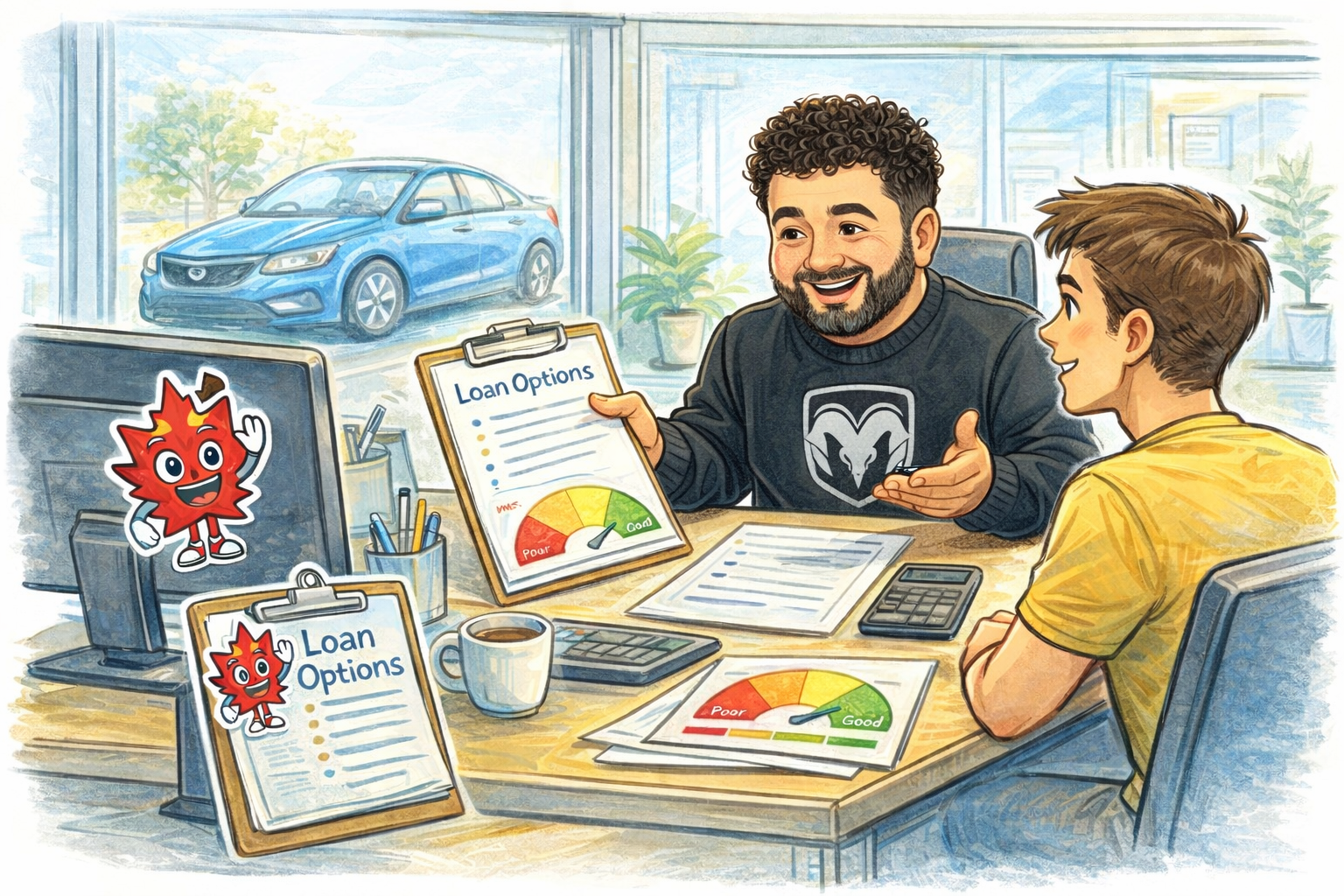
When lenders review a car loan application, they rarely base their decision on a single factor. While credit score gets the most attention, lenders actually evaluate the entire financial profile to determine whether a borrower can realistically handle the loan.
Think of it like a financial snapshot. Lenders want to see how you’ve managed credit in the past, how stable your income is today, and how much financial pressure you’re already carrying. If several factors suggest elevated risk, the lender may ask for a cosigner to strengthen the application.
Here are the main areas lenders review before deciding whether a cosigner is necessary.
3.1 Credit Score and Payment History
Your credit score and repayment history give lenders a quick picture of how reliably you’ve handled borrowed money.
This includes:
Whether you pay bills on time
How often accounts have been late
Any collections or negative marks
The age and mix of your credit accounts
Even when a borrower’s score is acceptable, lenders often look for stronger credit from a cosigner. Many lenders prefer cosigners with credit scores in the 680–700 range or higher, because that level of credit history typically indicates consistent repayment habits.
A cosigner with strong credit effectively reduces the lender’s risk by backing the loan with a proven borrower.
3.2 Income and Employment Stability
Income is another critical piece of the puzzle. Lenders need to confirm that you earn enough to comfortably handle the monthly payment alongside your existing expenses.
To verify income and employment, lenders may request documents such as:
Recent pay stubs
Tax documents (T4s or tax returns)
Bank statements showing deposits
Stable employment history also matters. Someone who has worked consistently for the same employer or within the same industry may appear less risky than someone with frequent job changes or unpredictable income.
If the borrower’s income looks inconsistent or insufficient relative to the loan amount, lenders may request a cosigner with stronger or more stable income documentation.
3.3 Debt-to-Income Ratio (DTI)
Lenders also evaluate how much of your income is already committed to existing debts. This is known as your debt-to-income ratio (DTI).
DTI compares your monthly debt obligations to your gross monthly income. For example, if you earn $4,000 per month and already spend $1,600 on debts, your DTI would be 40%.
While exact limits vary between lenders, many prefer borrowers to maintain a DTI somewhere below roughly 40–50%. If your existing financial obligations already consume a large portion of your income, lenders may worry that adding a car payment could create financial strain.
In those cases, a cosigner with a lower DTI and stronger financial profile may help balance the risk.
3.4 Loan Size and Vehicle Risk
The loan itself also influences whether a cosigner might be required.
Larger loan amounts increase financial exposure for the lender. Longer loan terms and higher payments can make approval more difficult, especially if the borrower’s financial profile is borderline.
The vehicle being financed can also affect the decision. Older vehicles or cars with higher mileage sometimes carry additional risk for lenders because:
The vehicle may depreciate faster
Mechanical issues may arise sooner
The collateral value may be lower
Because of these factors, lenders may require a stronger application — or a cosigner — when financing larger loans or higher-risk vehicles.
4. Situations Where You Probably Won’t Need a Cosigner
While cosigners can help some borrowers get approved, many people qualify for auto financing on their own. If your financial profile demonstrates stability and reliability, lenders often see you as a low-risk borrower.
Several factors make it much more likely that you’ll be approved without a cosigner.
4.1 Good or Excellent Credit Score
Borrowers with good credit scores — often around 660 or higher — are typically viewed as lower risk by lenders.
A strong score shows that you’ve managed credit responsibly over time. Consistent on-time payments, responsible credit usage, and a healthy credit history all signal that you’re capable of handling new debt.
Because of this, many borrowers with solid credit are approved without needing a cosigner at all.
4.2 Stable Income
Reliable income is another major indicator of approval potential.
If lenders can clearly see that your income comfortably covers the expected car payment — along with your other living expenses — they are far less likely to request additional security.
Steady employment and consistent earnings help demonstrate that you can sustain payments over the entire life of the loan.
4.3 Healthy Debt-to-Income Ratio
Even with good credit, lenders still look at how much financial pressure you’re already carrying.
Borrowers with manageable debt levels and a reasonable DTI — often below roughly 40–50% — typically have an easier time qualifying independently.
A lower DTI signals that you still have financial room to handle a car payment without putting your budget under stress.
4.4 Reasonable Loan Size
Finally, the size of the loan itself plays an important role.
Borrowers who finance vehicles within their budget are less likely to trigger lender concerns. Choosing a car with a payment that fits comfortably within your financial situation makes approval far more straightforward.
When credit, income, and debt levels all align with a reasonable loan amount, lenders are often comfortable approving the loan without requiring a cosigner.
5. Co-Signer vs Co-Buyer: A Critical Difference
When people research car financing, the terms cosigner and co-buyer are often used interchangeably. In reality, they mean very different things — especially when it comes to ownership and legal responsibility.
Understanding this distinction is important before agreeing to any financing arrangement. A cosigner and a co-buyer both share financial responsibility for the loan, but only one of them actually owns the vehicle.
5.1 What a Co-Signer Is
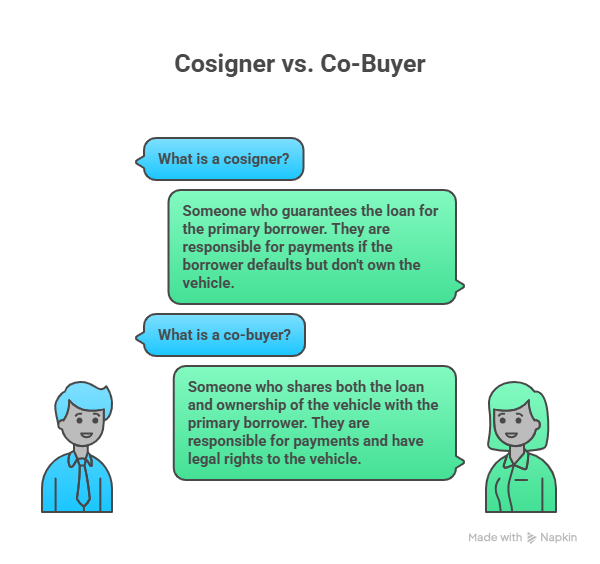
A cosigner is someone who agrees to guarantee the loan for the primary borrower.
Their role is to provide financial backing for the lender. If the borrower cannot make the payments, the cosigner becomes legally responsible for covering the debt.
Key characteristics of a cosigner include:
They guarantee the loan alongside the borrower
They are fully responsible for the payments if the borrower defaults
They do not own the vehicle
Their credit can be affected if payments are missed
Because of this responsibility, lenders typically require cosigners to have strong credit, stable income, and a healthy financial profile.
While cosigners provide security to the lender, they do not receive ownership rights to the vehicle being financed.
5.2 What a Co-Buyer Is
A co-buyer, sometimes called a co-borrower, is different.
Instead of simply guaranteeing the loan, a co-buyer shares both the loan and ownership of the vehicle with the primary borrower.
Key characteristics of a co-buyer include:
They share responsibility for the loan payments
They co-own the vehicle
Their name appears on the title and registration
Both borrowers have legal rights to the vehicle
This arrangement is common when two people plan to use or own the vehicle together, such as spouses or partners purchasing a car jointly.
In short:
Cosigner → Responsible for the loan but does not own the vehicle
Co-buyer → Responsible for the loan and shares ownership
Understanding this difference can help borrowers avoid confusion and make informed financing decisions.
🚗 Not Sure If You’ll Need a Cosigner?
The fastest way to find out is to check your car loan pre-approval. Many borrowers are approved on their own — even with less-than-perfect credit.
👉 Apply in about 60 seconds:
https://creditcarclubcanada.com/get-started-today
Credit Car Club Canada works with lenders that finance first-time buyers, newcomers to Canada, and bad credit applicants, so you can quickly see whether you qualify on your own or if a cosigner might help.
6. How a Cosigner Can Help You Get Approved
For borrowers who don’t quite meet lender requirements on their own, adding a cosigner can dramatically improve the chances of approval.
Because the cosigner brings stronger financial credentials to the application, lenders see the loan as significantly less risky.
Here are the main ways a cosigner can help.
Strengthens the Loan Application
A cosigner adds additional financial stability to the loan application. When lenders evaluate the deal, they consider the credit, income, and debt levels of both individuals.
If the cosigner has strong credit and steady income, the overall application becomes much more attractive.
Reduces Lender Risk
From the lender’s perspective, a cosigner creates a backup repayment source. If the primary borrower encounters financial trouble, the cosigner is legally responsible for the remaining balance.
This additional layer of protection makes lenders more comfortable approving loans that might otherwise be declined.
Improves Approval Chances
Many borrowers who struggle with:
low credit scores
limited credit history
inconsistent income
higher debt levels
may still qualify for financing when a qualified cosigner is added.
In some cases, adding a cosigner can turn a declined application into an approved loan.
May Reduce Interest Rates
A cosigner with strong credit can also improve the loan terms offered by lenders.
Because the risk of default decreases, lenders may offer:
lower interest rates
better financing terms
more flexible loan structures
This can reduce the total cost of the loan over time and make monthly payments more manageable.
For many borrowers — especially first-time buyers or those rebuilding credit — a cosigner can be the key that unlocks access to vehicle financing.
7. How to Avoid Needing a Cosigner
While a cosigner can help some borrowers qualify for a car loan, many people prefer to finance a vehicle independently. The good news is that there are several steps you can take to strengthen your application and improve your chances of approval on your own.
By improving key areas of your financial profile, you can reduce how risky you appear to lenders and make it easier to qualify without additional support.
7.1 Improve Your Credit Score
Your credit score is one of the most important factors lenders evaluate when approving a car loan. A higher score signals that you’ve handled credit responsibly in the past.
Some practical ways to improve your credit score include:
Paying all bills on time
Keeping credit card balances low
Avoiding unnecessary credit applications
Maintaining older credit accounts to build history
Even small improvements can make a difference. Borrowers with scores around 660 or higher often find it easier to qualify for financing without needing a cosigner.
7.2 Increase Your Down Payment
A larger down payment can significantly improve your loan application.
When you put money down on a vehicle, you reduce the total amount you need to borrow. This lowers the lender’s risk and shows that you’re financially committed to the purchase.
Benefits of a larger down payment include:
Smaller loan balance
Lower monthly payments
Improved chances of loan approval
In many cases, increasing your down payment can help offset weaker areas of your financial profile.
7.3 Lower Your Debt Load
Lenders closely monitor how much debt you already carry. If your credit cards, loans, and other obligations already consume a large portion of your income, approval becomes more difficult.
Reducing your overall debt load can improve your debt-to-income ratio and make your finances look healthier to lenders.
Steps that can help include:
Paying down credit card balances
Eliminating smaller personal loans
Avoiding new debt before applying for a car loan
A lower debt burden signals that you have more room in your budget to manage a new car payment.
7.4 Choose a More Affordable Vehicle
The size of the loan matters. Financing a vehicle that stretches your budget can increase the chance that lenders request a cosigner.
Instead, consider choosing a vehicle that fits comfortably within your financial situation. This may involve:
Selecting a less expensive model
Choosing a slightly older vehicle
Shortening the loan amount needed
When the loan amount aligns with your income and financial profile, lenders are more likely to approve the application without requiring a cosigner.
7.5 Show Stable Income
Lenders want to see that your income is consistent and reliable.
If you can demonstrate steady employment and regular earnings, it becomes easier for lenders to trust that you’ll keep up with payments over the life of the loan.
Ways to strengthen this part of your application include:
Maintaining consistent employment history
Providing recent pay stubs or tax documents
Showing stable deposits in your bank account
When lenders clearly see that you earn enough to cover the payment, the need for a cosigner often disappears.
8. When Getting a Cosigner Might Still Be Smart
Even if you technically qualify for a car loan on your own, adding a cosigner can sometimes still be a strategic decision.
In certain situations, a cosigner can improve the overall terms of the loan and make the financing process smoother.
Lower Interest Rates
A cosigner with strong credit can help secure better interest rates from lenders. Because the loan carries less risk, lenders may offer more competitive financing terms.
Lower interest rates can reduce the total cost of the loan and make monthly payments more affordable.
Stronger Financing Approval
In some cases, borrowers may qualify on their own but still sit near the lender’s risk threshold.
Adding a cosigner with excellent credit and stable income can strengthen the application and give lenders greater confidence in approving the loan.
Faster Approval Process
A strong cosigner can also speed up the approval process.
When lenders see a highly qualified borrower backing the loan, there may be fewer questions about risk. This can make the financing process faster and more straightforward, especially when purchasing a vehicle through a dealership.
9. Key Takeaway: What Determines If You Need a Cosigner
Whether you need a cosigner for a car loan ultimately comes down to how lenders evaluate your overall financial risk.
Auto finance companies don’t look at just one number when reviewing your application. Instead, they assess several factors together to determine whether you can realistically manage the loan on your own. The most important elements include your credit score, income level, debt obligations, employment stability, and the size of the loan you’re requesting.
Borrowers who demonstrate strong credit, steady income, manageable debt levels, and a reasonable loan amount often qualify for financing without needing a cosigner. These factors signal to lenders that the borrower has a reliable track record of repaying debt and the financial capacity to handle a new car payment.
On the other hand, applicants with thin credit history, lower credit scores, high existing debt, or inconsistent income may appear riskier to lenders. In these cases, adding a cosigner with stronger credit and stable finances can help strengthen the application and increase the likelihood of approval.
Understanding what lenders look for can help you prepare before applying for a car loan—and potentially qualify on your own without needing someone else to back the loan.
10. Sources and References
Cardeal Canada
https://www.cardealcanada.ca/getting-a-car-loan-with-a-co-signer/
Clutch
https://www.clutch.ca/blog/posts/co-signing-a-car-loan-in-canada-how-it-works
Hello Motors
https://hellomotors.ca/blog/how-co-signing-works-for-ontario-car-loans
Canada Drives
https://www.canadadrives.ca/blog/car-finance/getting-a-car-loan-without-a-cosigner-in-canada
Frequently Asked Questions (FAQ)
1. What credit score requires a cosigner for a car loan in Canada?
There isn’t a fixed credit score that automatically requires a cosigner. However, borrowers with credit scores below about 660 are often considered higher risk by lenders. If your score is low, your credit history is limited, or your financial profile is borderline, a lender may ask for a cosigner with stronger credit to help secure approval.
2. Can I still get a car loan without a cosigner if I have bad credit?
Yes, it is still possible. Many lenders in Canada specialize in subprime auto financing, which is designed for borrowers with lower credit scores or past credit challenges. While interest rates may be higher, approval can still happen without a cosigner if you have stable income and manageable debt levels.
3. Who can be a cosigner on a car loan?
A cosigner can typically be any adult with strong credit and stable income who is willing to take responsibility for the loan if payments are missed. This is often a parent, spouse, sibling, or close relative, but it can also be a trusted friend. Lenders usually prefer cosigners with credit scores around 680–700 or higher.
4. Does a cosigner own the vehicle?
No. A cosigner does not own the vehicle. Their role is only to guarantee the loan. If the borrower stops making payments, the cosigner becomes responsible for the remaining balance. If someone wants both responsibility for the loan and ownership of the vehicle, they would typically be listed as a co-buyer or co-borrower instead.
5. Can I remove a cosigner from a car loan later?
In most cases, a cosigner cannot simply be removed from the loan after approval. To remove them, the borrower usually needs to refinance the loan independently once their credit and financial profile have improved. Some lenders may allow refinancing after a period of on-time payments and stronger credit history.
