
What Credit Score Do You Need For a $30,000 Car Loan?
1. Introduction: The $30,000 Car Loan Question
Buying a vehicle around $30,000 has become incredibly common for Canadians today. Whether you’re looking at a newer used SUV, a reliable pickup, or a well-equipped sedan, this price range sits right in the middle of the modern car market. For many buyers, financing makes that purchase possible—but before approval ever happens, lenders look closely at one thing: your credit score.
Naturally, that leads to one of the most searched questions online: what credit score do you need for a $30,000 car loan?
The answer isn’t as rigid as many people expect. There is no universal minimum credit score that automatically approves or rejects a car loan. Different lenders have different risk tolerances, and approval decisions are based on several factors, not just your score. Still, patterns emerge across the Canadian lending landscape.
Most banks, credit unions, and dealership lenders share similar expectations when financing vehicles in this price range. In general, borrowers with stronger credit profiles find it much easier to qualify and receive competitive interest rates.
If you’re looking for a quick benchmark, many financial experts suggest aiming for a credit score of around 660 or higher. Reaching that level typically places you in the “good credit” range, which opens the door to more lenders, better approval odds, and lower borrowing costs.
2. Short Answer: What Credit Score Is Recommended for a $30,000 Car Loan?
If you want the straightforward answer, most Canadian lenders prefer borrowers with a credit score of about 660 or higher when financing a $30,000 vehicle.
In Canada’s credit-scoring system, a score of 660 falls into the “good credit” category. Buyers in this range generally qualify with many banks, dealership financing programs, and traditional auto lenders.
Once your score climbs above 700, your options usually expand even further. Borrowers in the prime credit range often receive lower interest rates, larger loan approvals, and more flexible loan terms. This can significantly reduce the total cost of financing a $30,000 car.
That said, having a score below 660 doesn’t automatically mean you’re out of the market. Many lenders—including specialized auto-finance companies—work with borrowers who have lower credit scores. However, these loans typically fall into near-prime or subprime categories, which means higher interest rates and stricter lending conditions.
In short, while 660+ is often the recommended target, approvals can still happen below that threshold—the difference is usually how much you’ll pay to borrow the money.
3. Canadian Credit Score Ranges Explained
Before understanding how lenders view a $30,000 car loan, it helps to know where your credit score falls within Canada’s scoring system.
In Canada, credit scores typically range from 300 to 900, with higher scores indicating lower lending risk. Lenders often group scores into broad categories to quickly assess how risky a borrower may be.
The most common breakdown looks like this:
Poor: 300–559
Borrowers in this range are considered high risk. Approval may still be possible through specialized lenders, but interest rates are usually very high.
Fair: 560–659
This range shows some credit history but also potential risk factors such as missed payments or limited credit depth. Financing is often possible, but terms may be less favorable.
Good: 660–724
This is where many traditional lenders begin to feel comfortable approving loans. Borrowers in this range typically qualify with most banks, credit unions, and dealership financing programs.
Very Good: 725–759
Borrowers here demonstrate strong credit management. Lenders often reward this with lower interest rates and more flexible loan terms.
Excellent: 760–900
This range represents the lowest lending risk. Borrowers with excellent credit usually receive the best available interest rates and loan offers.
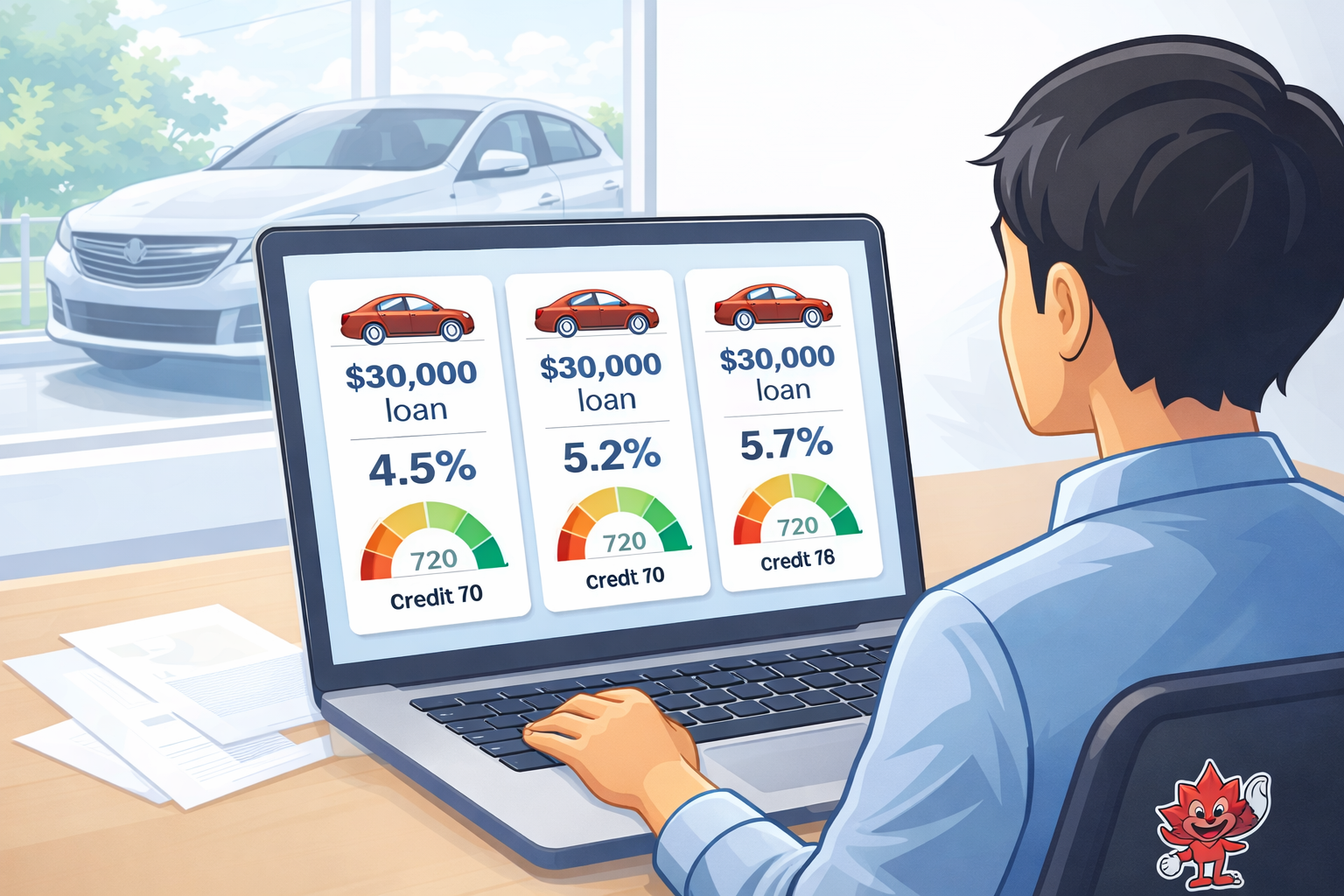
For a $30,000 car loan, most traditional lenders prefer borrowers with good credit or higher, because stronger credit signals reliability and reduces the lender’s risk. As your score climbs into the very good or excellent categories, you typically unlock better financing options, lower interest rates, and more competitive loan terms.
4. How Credit Score Affects a $30,000 Car Loan
Your credit score doesn’t just determine whether you qualify for a loan—it also plays a major role in how much that loan will cost you over time.
Auto lenders often group borrowers into credit tiers, which correspond to different interest rate ranges. These tiers help lenders price risk when financing vehicles.
A simplified breakdown of common auto loan tiers looks like this:
Super Prime (720+)
Borrowers in this range are considered the lowest risk. They typically qualify for the most competitive financing rates, often around 3.99% to 6.99% depending on the lender and market conditions.
Prime (670–719)
This range still represents strong credit. Buyers often receive solid loan terms, with interest rates commonly around 5.99% to 9.99%.
Near Prime (620–669)
Borrowers in this range may still qualify for a $30,000 loan, but lenders view them as moderate risk. Interest rates often rise to around 8% to 14% or higher.
Subprime (Below 620)
This tier represents higher lending risk. Borrowers may still obtain financing through alternative or specialized lenders, but rates frequently fall between 10% and 20% or more.
The difference between these tiers can dramatically affect the total cost of financing. A $30,000 car loan at a prime interest rate could cost thousands of dollars less over the life of the loan compared to the same loan financed at a subprime rate. Even small differences in interest can significantly change monthly payments and total borrowing costs.
5. Why Lenders Often Recommend a 660+ Credit Score
You’ll often see financial experts mention 660 as a recommended credit score when discussing car loans around $30,000. This number isn’t random—it comes from how lenders categorize risk within the Canadian credit system.
A score of 660 sits at the lower edge of the “good credit” range, which typically begins around that level. Once borrowers cross into this category, lenders generally view them as more reliable and financially stable compared to those with lower scores.
Because of this, many Canadian finance guides suggest aiming for at least 660 when financing a vehicle in the $30,000 range. At this level, borrowers usually gain access to a wider pool of lenders and more conventional financing options.
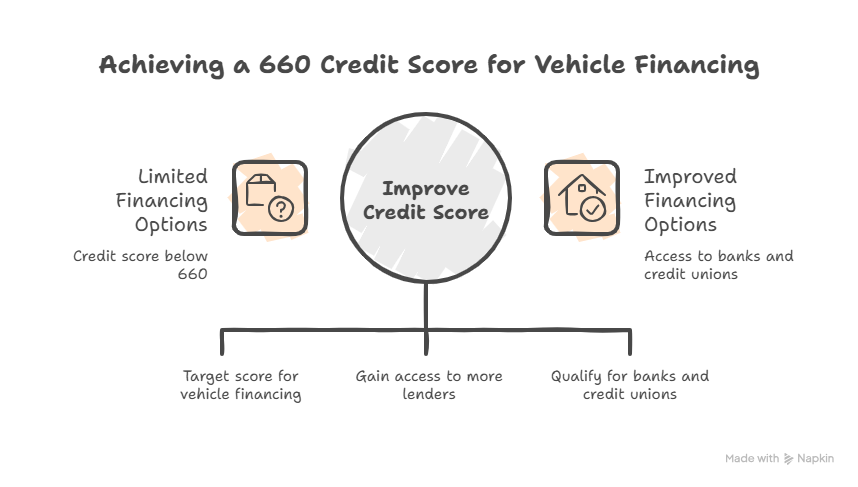
Buyers with credit scores around 660 or higher can often qualify with:
Banks
Credit unions
Dealership financing programs
Major auto lenders
Several well-known Canadian financial resources support this benchmark. For example, finance guides from Loans Canada, Spring Financial, and Canada Drives commonly point to 660 as a practical target score for vehicle financing in this price range. They also note that moving into the 700+ range can unlock even better interest rates and loan terms.
In other words, 660 isn’t a strict rule, but it represents a threshold where many lenders begin offering more favorable financing conditions.
6. Why There Is No “Minimum Credit Score” for a Car Loan
One of the biggest misconceptions about auto financing is the idea that there is a specific credit score you must reach before you can qualify for a car loan.
In reality, no universal minimum credit score exists for auto financing. Lenders use different risk models and approval criteria, meaning one lender may approve a borrower that another declines.
Because of this, some lenders are willing to work with borrowers whose scores fall in the low 600s or even below. These loans often come from alternative lenders or specialized auto-finance companies that focus on helping buyers with limited or damaged credit.
Instead of relying on a single number, lenders evaluate a borrower’s overall financial profile. Several key factors play a role in the final approval decision, including:
Credit history
Lenders review how consistently you have made payments in the past and whether there are delinquencies, collections, or high credit utilization.
Income and employment stability
Stable income and steady employment help lenders determine whether you can reliably make monthly payments.
Debt-to-income ratio
Existing financial obligations—such as credit cards, personal loans, or mortgages—affect how much additional debt you can reasonably carry.
Down payment
A larger down payment reduces the lender’s risk and can improve approval odds.
Vehicle age and value
Newer vehicles or those with strong resale value are generally easier to finance than older or high-mileage vehicles.
Because lenders weigh all of these factors together, a borrower with a slightly lower credit score but strong income, stable employment, and a reasonable down payment may still qualify for a $30,000 car loan.
7. Other Factors That Affect Approval for a $30,000 Loan
While credit score plays a major role in auto financing, it’s only one part of the equation. When lenders evaluate a $30,000 car loan application, they look at several financial indicators to determine whether the borrower can reliably handle the monthly payments.
Understanding these factors can help explain why some buyers are approved even with average credit, while others with decent scores may still struggle to qualify.
Income and employment
One of the first things lenders review is income and job stability. A steady paycheck and consistent employment history demonstrate that you have the financial capacity to support a car loan payment over time. Borrowers with stable income typically present lower risk to lenders.
Debt-to-income ratio
Lenders also consider your debt-to-income ratio, which measures how much of your monthly income is already committed to other financial obligations. If a large portion of your income is going toward credit cards, loans, or other debts, lenders may hesitate to approve additional borrowing.
Down payment
A larger down payment can significantly improve approval chances. By putting money down upfront, you reduce the amount being financed, which lowers the lender’s risk and can sometimes lead to better loan terms.
Vehicle choice
The type of vehicle you’re financing also matters. Newer vehicles or those with strong resale value are generally easier to finance because they represent less risk if the lender ever needs to recover the asset.
Taken together, these financial factors can sometimes offset a lower credit score. For example, a borrower with slightly weaker credit but strong income, a stable job, and a solid down payment may still qualify for a $30,000 car loan.
Ready to See If You Qualify?
If you're looking to finance a vehicle and want to know what you qualify for, you can apply for a car loan in under 60 seconds.
✔ No obligation
✔ All credit situations considered
✔ Fast approvals across Canada
👉 Start your application here:
https://creditcarclubcanada.com/get-started-today
8. Can You Get a $30,000 Car Loan With Bad Credit?
Many buyers assume that a lower credit score automatically disqualifies them from financing a vehicle, but that isn’t always the case. Even with credit scores below 660, some borrowers can still qualify for a $30,000 car loan, although the terms may be less favorable.
Borrowers in the near-prime range (approximately 620–669) may still qualify with many lenders. While approval is possible, interest rates are typically higher and lenders may require stricter conditions, such as stronger income verification or a larger down payment.
For borrowers with subprime credit (below about 620), financing options often come from alternative or specialized lenders who focus on helping people with challenged credit histories. These loans are more expensive because lenders charge higher interest rates to offset the increased risk. In some cases, lenders may also request proof of income, stable employment, or a down payment before approving the loan.
Despite the higher costs, many borrowers use these loans strategically. A high-interest car loan can sometimes serve as a stepping stone to rebuild credit. By making consistent on-time payments for several months or years, borrowers may improve their credit score and eventually refinance the loan at a lower interest rate once their credit improves.
9. Key Takeaway: What Credit Score Do You Need for a $30,000 Car Loan?
If you’re planning to finance a $30,000 vehicle, the most important thing to understand is that there is no fixed minimum credit score required for approval. Every lender evaluates applications differently, and approvals depend on a combination of financial factors rather than a single number.
However, across Canada’s lending market, a clear pattern exists. Most banks, credit unions, and dealership lenders generally prefer borrowers with credit scores around 660 or higher, which falls into the good credit category. Buyers in this range typically find it much easier to qualify for financing with mainstream lenders.
Once your credit score reaches 700 or higher, financing options often become even more competitive. Borrowers in this range can often access lower interest rates, better loan terms, and more flexible approvals, which can significantly reduce the total cost of financing a $30,000 car.
Even if your credit score is below 660, approval may still be possible. Many lenders specialize in near-prime or subprime auto loans, helping buyers with less-than-perfect credit obtain financing. The trade-off is usually higher interest rates and stricter loan conditions.
In the end, lenders evaluate your full financial profile, not just your credit score. Factors such as stable income, manageable debt levels, a down payment, and the vehicle being financed can all influence approval.
If you’re wondering whether you qualify, you can apply for a car loan in under 60 seconds here:
👉 https://creditcarclubcanada.com/get-started-today
10. Sources and References
The information in this article is based on research and guidance from established financial and automotive finance resources.
Loans Canada
Credit score requirements for auto loans and Canadian credit ranges.
https://loanscanada.ca/auto/what-credit-score-do-you-need-for-a-car-loan/
Spring Financial
Guidance on recommended credit scores for financing vehicles and how scores affect loan approval.
https://www.springfinancial.ca/blog/credit-tips/credit-score-needed-for-a-car
Canada Drives
Canadian auto financing insights and credit score expectations for vehicle purchases.
https://www.canadadrives.ca/blog/car-finance/credit-score-needed-to-get-a-car-loan
BrokerLink
Breakdown of Canadian credit score ranges and how lenders interpret them.
https://www.brokerlink.ca/blog/what-credit-score-is-needed-for-a-new-car
Safelend
Explanation of prime, near-prime, and subprime auto loan tiers in Canada.
https://www.safelend.ca/post/subprime-auto-loans-canada
Hello Motors
Average Canadian auto loan interest rates by credit tier.
https://hellomotors.ca/blog/average-auto-loan-rates-by-credit-score-in-canada
OCAL Financial
Auto loan approval insights and factors lenders use to evaluate borrowers.
https://ocalfinancial.ca/what-credit-score-is-needed-for-a-car-loan-insider-tips-for-2025/
Experian
Overview of credit scores and how they influence auto loan approval and rates.
https://www.experian.com/blogs/ask-experian/what-is-a-good-credit-score-for-an-auto-loan/
FAQ
1. What credit score is needed to get a $30,000 car loan in Canada?
Most lenders prefer borrowers with a credit score of around 660 or higher when financing a $30,000 vehicle. This falls into the good credit range, which typically allows buyers to qualify with many banks, credit unions, and dealership financing programs. While higher scores can unlock better interest rates, approval is still possible with lower scores depending on the lender and financial profile.
2. Can I get a $30,000 car loan with a 600 credit score?
Yes, it is possible to qualify for a $30,000 car loan with a credit score around 600, but the loan will likely fall into the near-prime or subprime category. This usually means higher interest rates and stricter approval conditions. Lenders may also look closely at factors such as income, employment stability, and whether you can provide a down payment.
3. What interest rate can I expect for a $30,000 car loan?
Interest rates vary based on your credit score and lender. Borrowers with prime or super-prime credit (roughly 670–720+) may see rates around 4% to 9%, while those with lower credit scores may face rates above 10% or even into the mid-teens. The stronger your credit profile, the lower your potential borrowing cost.
4. Can I still qualify if my credit score is below 660?
Yes. Many lenders specialize in helping borrowers with lower credit scores obtain financing. These loans often come from near-prime or subprime lenders, which work with buyers who may have past credit challenges. However, these loans usually carry higher interest rates to offset the additional risk.
5. How can I improve my chances of getting approved for a $30,000 car loan?
Beyond your credit score, lenders also evaluate your overall financial profile. You can improve your approval chances by maintaining stable employment, reducing existing debt, making a larger down payment, and choosing a reliable vehicle with strong resale value. Demonstrating responsible financial habits can help lenders feel more confident approving your loan.
