
Can You Get a Car Loan With a 500 Credit Score?
1. Introduction: The Question Many Car Buyers Ask
For many Canadians, the moment they see a credit score around 500, a wave of doubt follows close behind. Can you still finance a car? Or does that number automatically shut the door on approval?
The short answer is yes, it is still possible to finance a car with a 500 credit score—but the path to approval looks different than it does for borrowers with stronger credit. A score in the 500 range is typically considered poor credit, which places you in what lenders call the subprime category. That classification signals higher risk to lenders, usually because of past missed payments, collections, or heavy credit usage.
Traditional banks and credit unions tend to prefer applicants with credit scores around 620–660 or higher for standard auto loans. However, that does not mean financing is impossible if your score is lower. In fact, an entire segment of the lending industry exists specifically to help borrowers with bad credit car loans. These lenders look beyond your credit score and may focus more heavily on other factors such as income, employment stability, and the type of vehicle being financed.
If you are wondering whether a 500 score completely blocks your chances of getting a vehicle, the reality is more nuanced. Many Canadians with similar credit scores are approved for financing every year—often through lenders designed to work with subprime borrowers.
In this guide, we will break down exactly what you need to know, including:
Whether approval is actually possible with a 500 credit score
How lenders evaluate borrowers in the subprime category
What interest rates and loan conditions typically look like
Practical ways to increase your chances of approval
By the end of this article, you will have a clear picture of what financing a car with a 500 credit score really looks like—and what steps you can take to improve your odds.
2. What a 500 Credit Score Means in Canada
In Canada, credit scores generally range from 300 to 900, with higher numbers representing stronger creditworthiness. Lenders use these scores as a quick way to estimate the likelihood that a borrower will repay a loan on time.
A 500 credit score sits near the lower end of that scale, which is why most lenders classify it as poor credit. This does not necessarily mean someone is irresponsible with money. In many cases, it simply reflects financial challenges that happened in the past.
Several common factors can lead to a credit score falling into the 500 range.
One of the most frequent causes is missed or late payments. Even a few payments reported late to credit bureaus can significantly lower a credit score. Over time, repeated late payments signal to lenders that a borrower may have difficulty managing debt obligations.
Another major factor is accounts in collections. When unpaid debts are sent to collection agencies, they leave a serious mark on a credit report and can quickly drag a score downward.
A high level of credit utilization can also contribute to a lower score. This happens when someone is using a large percentage of their available credit limits on credit cards or lines of credit. High balances relative to limits can indicate financial strain to lenders.
Some borrowers also have a lower score because of limited credit history. If someone has only recently started using credit—or has very few accounts—there may not be enough data for credit bureaus to calculate a stronger score.
Because of these factors, borrowers with a 500 score are typically placed in the subprime lending category. In the auto finance world, subprime borrowers are considered higher risk, which is why lenders often apply stricter requirements or higher interest rates when approving loans.
However, being in the subprime category does not automatically mean financing is out of reach. It simply means lenders will look more closely at other indicators—such as income stability and employment history—before making an approval decision.
3. Can You Actually Get Approved With a 500 Credit Score?
The question many people ask is simple: Can you really get approved for a car loan with a 500 credit score?
The answer is yes—approval is possible, but the lender you work with matters.
One of the biggest misconceptions about auto financing is that there is a strict minimum credit score required to get approved. In reality, there is no universal minimum credit score for a car loan. Each lender sets its own criteria when evaluating borrowers.
That said, the type of lender plays a major role in whether approval is likely.
Traditional banks and credit unions typically prefer borrowers with credit scores around 600 to 660 or higher. These lenders focus heavily on credit history because they aim to lend to lower-risk customers. For someone with a score around 500, approval through a bank is generally difficult unless there are strong compensating factors.
However, many alternative auto lenders and bad-credit financing programs exist specifically for borrowers who fall below those thresholds. Some online lenders and specialized auto finance companies are willing to work with applicants whose scores fall between roughly 300 and 580, including those around the 500 range.
Instead of relying only on the credit score, these lenders look more closely at other signs that the borrower can handle a car payment.
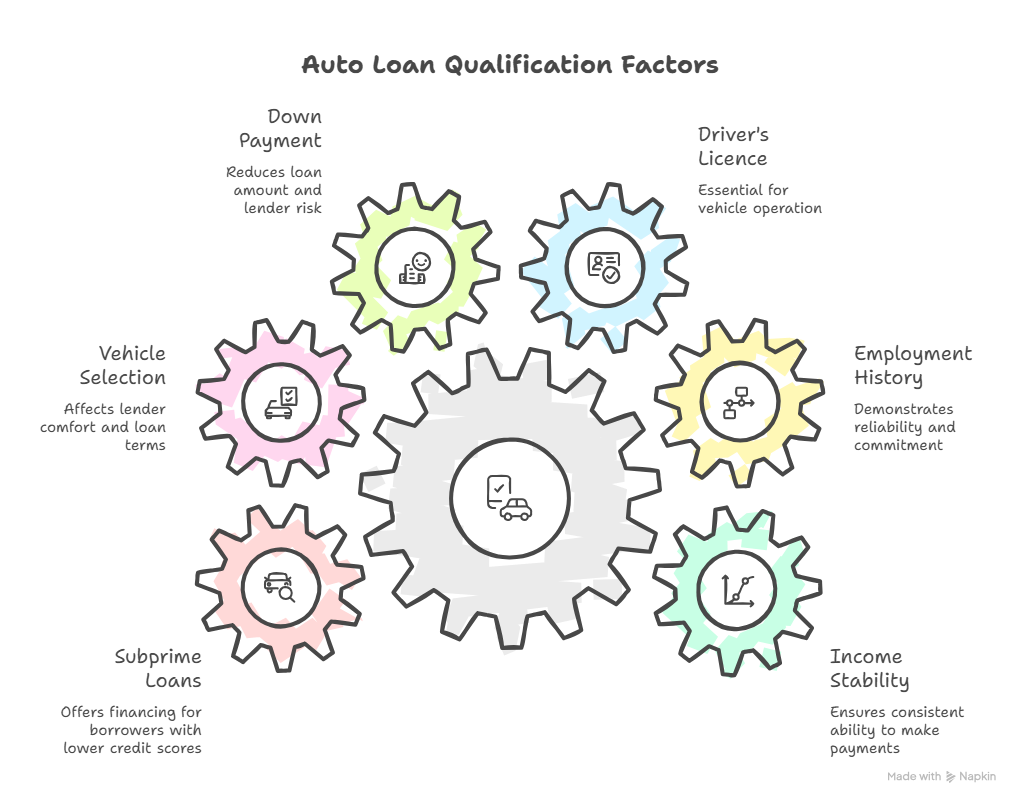
For example, approval may depend on factors such as:
Income stability. Lenders want to see that you have enough monthly income to comfortably afford the loan payment.
Employment history. Many lenders prefer applicants who have been employed for at least a few months at their current job.
Driver’s licence status. A valid licence is usually required to qualify for auto financing.
Down payment. A larger down payment reduces the loan amount and lowers the lender’s risk.
Vehicle selection. Lenders are often more comfortable financing vehicles that are reasonably priced and mechanically reliable.
Because these additional factors matter so much, a borrower with a 500 credit score but stable income and employment may still qualify for financing through lenders that specialize in subprime auto loans.
4. How Auto Lenders Classify Credit Scores
To understand how lenders evaluate borrowers, it helps to know how auto loan credit tiers work.
Most lenders group applicants into categories based on their credit score. These tiers help determine the interest rate, loan terms, and approval likelihood for a car loan.
Prime Borrowers
Prime borrowers typically have credit scores of around 670 or higher. This group represents the lowest risk to lenders.
Because of their strong credit history, prime borrowers usually qualify for:
The lowest interest rates
The widest range of financing options
Longer loan terms and better payment structures
Lenders compete aggressively for these borrowers because they are statistically the most likely to repay loans on time.
Near-Prime Borrowers
Near-prime borrowers generally fall into the 620 to 669 credit score range.
While their credit may include minor issues or shorter credit histories, they are still considered relatively reliable borrowers. As a result, they can often qualify for financing through traditional lenders, though their interest rates are typically higher than those offered to prime borrowers.
Many dealerships and banks still approve borrowers in this category without major restrictions.
Subprime Borrowers
Subprime borrowers have credit scores below roughly 620. This category includes individuals with scores in the 500 range.
Because subprime borrowers are considered higher risk, lenders usually apply:
Higher interest rates
Stricter loan requirements
Possible limits on vehicle age, mileage, or price
A borrower with a 500 credit score sits firmly within the subprime category, which means financing may still be available but often comes with different terms compared to loans offered to higher-credit borrowers.
Understanding these credit tiers helps explain why some lenders may decline an application while others specialize in helping borrowers with lower credit scores secure financing.

5. What Car Loan Approval Looks Like With a 500 Score
If your credit score sits around 500, getting approved for a car loan usually looks different than it does for borrowers with stronger credit. Approval is still possible, but lenders will often apply stricter requirements and higher interest rates to offset the additional risk.
Instead of focusing only on your credit history, many lenders will evaluate the full financial picture. This includes factors such as your income, employment stability, and the vehicle you want to purchase. Understanding what lenders typically expect can help you prepare before applying for financing.
5.1 Types of Lenders That May Approve You
Not all lenders evaluate credit scores the same way. Some institutions are far more flexible than others when working with borrowers who have lower credit scores.
Banks and credit unions
Traditional financial institutions are generally the most conservative when it comes to auto lending. Many banks and credit unions prefer applicants with credit scores in the 600 to 660 range or higher. Because of this, borrowers with a 500 credit score may find approval difficult through these lenders unless other factors strongly support the application.
Online auto lenders
Some online auto finance platforms are more flexible and may accept applicants with credit scores between roughly 300 and 580. These lenders often use automated systems that evaluate several variables, including income and employment history, rather than relying only on a credit score.
Subprime or bad-credit lenders
Subprime lenders specialize in helping borrowers whose credit scores fall below 620. Many dealership finance departments work with these lenders to help customers secure approval even when traditional banks decline the application.
In these cases, lenders frequently focus on income stability and job history rather than just the credit score itself. A borrower with a 500 credit score but steady employment and reliable income may still qualify for financing through lenders designed to serve the subprime market.
5.2 Interest Rates for a 500 Credit Score
While approval may be possible, borrowers with a 500 credit score should expect higher interest rates compared with those with stronger credit.
Subprime auto loans often carry interest rates in the range of 10% to 20% or more. In very high-risk situations, some loans can approach 30% APR, particularly when credit history includes recent negative marks.
Higher interest rates significantly increase the overall cost of the loan. Even if the monthly payment appears affordable, the total amount paid over the life of the loan can be much higher than expected.
For example, higher interest rates mean:
A larger total loan cost
More interest paid over time
A longer period before building meaningful equity in the vehicle
Because of this, borrowers with a 500 credit score often treat their initial loan as a temporary step toward rebuilding credit, with the goal of refinancing later once their credit improves.
5.3 Other Conditions Lenders May Require
In addition to higher interest rates, lenders often apply several other requirements when approving borrowers with lower credit scores.
Common approval conditions may include:
Proof of stable income
Lenders typically want documentation showing that you earn enough income to comfortably afford the loan payments.
Minimum monthly income
Some lenders require applicants to earn around $1,500 to $2,000 or more per month before considering approval.
Employment stability
Many lenders prefer applicants who have been employed for at least three months at their current job.
Valid driver’s licence
A current driver’s licence is generally required for auto financing.
Age of majority
Applicants must be legally able to enter a contract in their province.
Down payment
Some lenders may request a down payment to reduce the loan amount and lower their risk.
Vehicle restrictions
Lenders may limit the types of vehicles they will finance. Restrictions can include maximum age, mileage limits, or price caps on the vehicle being purchased.
These conditions help lenders reduce risk while still allowing borrowers with lower credit scores to obtain financing.
6. How to Improve Your Chances of Getting Approved
Even if your credit score is around 500, there are several steps you can take to improve your chances of getting approved for a car loan. Many lenders evaluate multiple factors beyond credit, and strengthening these areas can make your application more attractive.
Bring a Larger Down Payment
A larger down payment can significantly improve your approval chances. By paying part of the vehicle’s price upfront, you reduce the total amount the lender needs to finance.
This lowers the lender’s risk and may also help reduce your monthly payment.
Choose a Lower-Cost Vehicle
Selecting a modest and reliable vehicle can also improve approval odds. Lenders are typically more comfortable financing vehicles that are reasonably priced and less likely to require major repairs.
Lower loan amounts make financing easier for borrowers with weaker credit.
Show Stable Income and Employment
One of the most important factors lenders consider is consistent income. Demonstrating that you have steady employment and reliable earnings helps reassure lenders that you can manage the loan payments.
Stable job history is often one of the strongest indicators lenders use when evaluating subprime borrowers.
Add a Co-Signer
If possible, adding a co-signer with stronger credit can greatly improve the chances of approval. A co-signer agrees to take responsibility for the loan if the primary borrower cannot make payments.
Because this reduces risk for the lender, it can make approval easier and may even result in better loan terms.
Get Pre-Approved
Using an online pre-approval tool can give you a clearer picture of what financing options are available before visiting a dealership. Pre-approval tools often estimate:
Whether you may qualify for financing
What payment range to expect
Which lenders may be willing to work with your credit profile
Getting pre-approved can save time and help you shop for a vehicle with a realistic budget in mind.
7. Risks of Financing a Car With a 500 Credit Score
Financing a car with a 500 credit score can open the door to transportation when you need it most. But it’s important to understand the trade-offs that often come with subprime auto loans. Knowing the risks ahead of time helps you make smarter decisions and avoid costly mistakes.
Higher Total Loan Cost
The biggest downside of a subprime car loan is the higher interest rate. As discussed earlier, borrowers with lower credit scores often face interest rates in the double-digit range, sometimes exceeding 20%.
Even if the monthly payment looks manageable, those higher rates can significantly increase the total amount paid over the life of the loan. Over several years, borrowers may end up paying thousands of dollars more in interest compared to someone with stronger credit.
Because of this, it’s important to look beyond the monthly payment and focus on the total cost of the loan.
Risk of Negative Equity
Another challenge is the possibility of negative equity, sometimes referred to as being “upside down” on a car loan.
Vehicles naturally lose value over time through depreciation. When a loan carries a high interest rate, the loan balance may decrease more slowly than the vehicle loses value. This can lead to a situation where you owe more on the loan than the car is actually worth.
Negative equity can make it harder to sell or trade in the vehicle later, especially if the loan balance remains high.
Predatory Lending Risks
Unfortunately, borrowers with poor credit are sometimes targeted by predatory lending practices. While many lenders operate ethically, some dealerships or finance programs may take advantage of borrowers who feel they have limited options.
Common warning signs can include:
Hidden fees buried within the financing agreement
Expensive add-ons such as extended warranties or insurance products that inflate the loan amount
Inflated vehicle pricing, where the car itself is priced significantly above market value
To protect yourself, always take the time to read the loan contract carefully before signing. Pay close attention to the interest rate, total loan cost, fees, and any optional products included in the financing package.
Asking questions and reviewing the terms thoroughly can help ensure that the financing agreement truly fits your budget and long-term financial goals.
8. A Smarter Strategy: Use the Loan to Rebuild Your Credit
While financing a vehicle with a 500 credit score may involve higher costs, it can also serve a valuable purpose if approached strategically.
For many borrowers, a subprime auto loan becomes an opportunity to rebuild their credit profile.
One helpful mindset is to treat a higher-interest loan as a temporary step rather than a long-term financial solution. By making consistent, on-time payments, borrowers can begin creating a positive payment history that gradually improves their credit score.
Most credit experts recommend focusing on perfect payment history for at least 6 to 18 months. During that time, each successful payment helps demonstrate reliability to future lenders.
As your credit score improves, new opportunities may become available. One common strategy is to refinance the auto loan once credit has recovered. Refinancing allows borrowers to replace the original high-interest loan with a new loan that carries a lower interest rate and potentially lower monthly payments.
Over time, this approach can reduce the total interest paid while continuing to strengthen your credit profile.
For borrowers starting with a 500 credit score, the right auto loan can become more than just transportation—it can also become a stepping stone toward stronger financial health.
9. Key Takeaway: Can You Finance a Car With a 500 Credit Score?
So, can you finance a car with a 500 credit score?
Yes, it is possible. (you can apply right here :)
But the path to approval usually looks different than it does for borrowers with stronger credit profiles.
A credit score in the 500 range places you firmly in the subprime category, which means traditional banks and credit unions may decline your application. Many of these lenders prefer applicants with scores closer to 600–660 or higher before offering standard auto financing.
However, that doesn’t mean you’re out of options. Many alternative lenders and subprime auto finance programs exist specifically to help borrowers with lower credit scores obtain vehicle financing. These lenders often look beyond credit history and evaluate other factors such as income stability, employment history, and the type of vehicle being financed.
Borrowers should still expect higher interest rates and stricter requirements, since lenders are taking on more risk when approving a loan for someone with poor credit. Conditions such as proof of income, job stability, or a down payment are commonly used to offset that risk.
The good news is that several factors can improve your chances of approval. Having stable income, consistent employment, a reasonable down payment, and selecting a reliable vehicle within a modest price range can make lenders much more comfortable approving the loan.
For many Canadians, a subprime auto loan becomes not just a way to obtain transportation, but also an opportunity to rebuild credit and work toward stronger financing options in the future.
10. Sources and References
The information in this guide is based on research and insights from several Canadian auto finance resources and lending experts.
Canada Drives – Minimum requirements for bad-credit auto loans and how lenders evaluate applicants with lower credit scores.
https://www.canadadrives.ca/blog/car-finance/minimum-requirements-for-car-loan-with-bad-credit
Canada Drives – Guidance on qualifying for car financing with poor credit in Canada.
https://www.canadadrives.ca/blog/car-finance/how-to-qualify-for-car-financing-with-bad-credit-in-canada
Finder Canada – Information on credit score ranges used by lenders and general requirements for car loans.
https://www.finder.com/ca/car-loans/car-loans-credit-check
Loans Canada – Overview of credit score expectations for auto loans and financing options for borrowers with bad credit.
https://loanscanada.ca/auto/what-credit-score-do-you-need-for-a-car-loan/
Safelend – Explanation of prime, near-prime, and subprime auto loan categories and typical interest rate ranges.
https://www.safelend.ca/post/subprime-auto-loans-canada
OCAL Financial – Insights into approval factors for auto loans, including income, employment, and credit score considerations.
https://ocalfinancial.ca/what-credit-score-is-needed-for-a-car-loan-insider-tips-for-2025/
Canada Auto Approval – Information on obtaining used car financing with bad credit in Canada.
https://canadaautoapproval.ca/bad-credit/
Byrider – Example of bad-credit auto financing programs that evaluate factors beyond credit scores.
https://www.byrider.com/can-i-get-a-car-loan-with-a-500-credit-score
