
Can a Student Finance a Car in Canada?
1. Introduction: Can Students Actually Get Car Loans in Canada?
Picture this: it’s a cold morning on campus. The bus is late, your shift starts in 40 minutes, and the walk across town suddenly feels a lot longer than it did when you first moved to the city. For many students in Canada, owning a car isn’t a luxury—it’s the difference between making it to class, work, or an internship on time.
Naturally, that leads to a big question many students ask: Can a student actually finance a car in Canada?
The short answer is yes — students can finance a car in Canada. However, approval usually depends on a few important factors such as income, credit history, and the type of lender you apply with.
Traditional banks sometimes hesitate to approve borrowers who have limited income or little credit history. But that doesn’t mean students are out of options. In many cases, dealership lenders, auto finance brokers, and online financing platforms are more flexible and specialize in working with people who are new to credit or just starting their financial journey.
In this guide, we’ll break down everything students need to know about car financing in Canada, including:
The basic requirements lenders look for
Student and graduate financing programs offered by some lenders
Options available for international students studying in Canada
Practical strategies that can improve a student’s chances of getting approved
By the end of this article, you’ll have a clear understanding of whether financing a vehicle as a student is possible—and what steps can help make it happen.
2. Can Students Get a Car Loan in Canada?
Yes, Canadian lenders do approve car loans for students, but approval isn’t automatic. Like any auto loan, lenders evaluate several factors to determine whether a borrower can realistically handle the payments.
In most cases, lenders focus on four key areas when reviewing a student’s application:
Minimum age – You must be at least the age of majority in your province (typically 18 or 19).
Residency status – Most lenders require borrowers to be Canadian residents or have legal status in Canada.
Income – Having reliable income, even from part-time work, helps show lenders you can afford the payments.
Credit profile – A credit history with on-time payments can improve approval chances and interest rates.
Students who have steady income and some established credit history may be able to qualify for financing through traditional lenders such as banks or credit unions. However, many students are just beginning to build credit, which can make approval through banks more difficult.
The good news is that students with little or no credit history may still qualify through alternative financing options, including:
Dealership financing programs
Online auto financing platforms
Auto loan broker networks
These lenders often work with borrowers who have thin credit files or limited borrowing history, making them a common path for first-time car buyers.
Ultimately, lenders are less concerned about whether you are a student and more focused on one key factor: your ability to repay the loan. If you can demonstrate stable income and responsible financial habits, financing a vehicle as a student can be very achievable in Canada.
3. Typical Requirements for a Student Car Loan
Getting approved for a car loan as a student in Canada usually comes down to one central question lenders ask themselves: Can this borrower realistically repay the loan?
While every lender has slightly different criteria, most of them look at a similar set of fundamentals when reviewing a student’s application. These include age and residency status, proof of income, credit history, and the documentation that verifies your financial situation.
Understanding these requirements ahead of time can help students prepare a stronger application and avoid surprises during the financing process.
3.1 Age and Residency Requirements
Before anything else, lenders must confirm that the borrower is legally allowed to enter into a loan agreement.
In Canada, this generally means you must be at least the age of majority in your province, which is typically 18 or 19 years old depending on where you live. Only individuals who meet this requirement can legally sign a loan contract.
Most lenders also require borrowers to be Canadian residents or have legal status in Canada. This could include citizens, permanent residents, or individuals with valid permits that allow them to live and work in the country.
Because a car loan is a legally binding agreement, lenders must ensure that the borrower is eligible to sign and be responsible for the contract under Canadian law.
3.2 Income and Employment
Even if you’re a student, lenders still need to see evidence that you have reliable income to cover monthly payments.
Income does not necessarily have to come from a full-time career. Many students qualify for car financing while working part-time or balancing work and school.
Common income sources that lenders may accept include:
Part-time employment
Full-time employment
Consistent self-employment income
To verify this income, lenders typically ask applicants to provide documentation such as:
Recent pay stubs
Bank statements
Employer contact information
These documents help lenders confirm that your income is stable enough to support the loan payments alongside your other expenses.
3.3 Credit History
Your credit history plays an important role in car loan approval. Lenders use your credit profile to understand how you have handled borrowed money in the past.
Students who already have some credit history—such as a credit card or small loan—may find it easier to get approved, especially if they have made on-time payments consistently.
However, many students have thin credit files, meaning they have little or no borrowing history. In these situations, traditional banks may be more cautious. Fortunately, some lenders specialize in working with borrowers who are just starting to build credit.
It’s also important to understand that credit history influences interest rates. Borrowers with stronger credit profiles typically receive lower rates, while limited credit history may lead to higher rates until credit is established.
3.4 Required Documents
To complete a car loan application, lenders typically ask students to provide several documents that verify identity, income, and financial obligations.
Common documents include:
Government-issued photo ID
Proof of address
Proof of income
Bank statements
Down payment information
Details about existing debts
These documents allow lenders to confirm who you are, where you live, and whether your financial situation supports taking on a car loan.
Preparing these items in advance can make the financing process much smoother and faster for students applying for their first vehicle.

4. Special Car Loan Programs for Students
While traditional auto loans are available to many borrowers, some financing options are specifically designed to help students and recent graduates obtain vehicles even with limited work history or credit.
These programs recognize that students often have strong future earning potential, even if their current income or credit profile is still developing.
Two of the most common financing routes available to students include standard auto lenders and specialized graduate loan programs.
4.1 Standard Auto Lenders and Online Platforms
In recent years, online auto financing platforms have become one of the easiest ways for students to explore their financing options.
These platforms typically work by matching borrowers with lenders and dealerships that are willing to finance their vehicle purchase. Instead of applying to multiple lenders individually, students can often complete one application and receive financing options based on their financial profile.
One of the biggest advantages of this approach is pre-approval. Getting pre-approved for a car loan can help students understand:
Their budget
Estimated monthly payments
The likelihood of approval before visiting a dealership
Many of these lenders also promote approvals for all credit types, including borrowers with limited or newly established credit histories. This makes online platforms a common starting point for students who are unsure about their financing eligibility.
4.2 Graduate Car Loan Programs
Some banks in Canada offer graduate-specific auto loan programs designed for students who are about to enter the workforce or have recently completed their studies.
These programs recognize that graduates may not yet have a long work history but will soon have a stable income.
Features of graduate car loan programs may include:
Financing before starting a full-time job
Delayed payments for the first few months
Financing for new or late-model used vehicles
Low or no down payment options
Because these programs are designed for students and recent graduates, lenders often focus more on future earning potential rather than long-established credit history.
For students who are finishing school and preparing to begin their careers, graduate auto loan programs can provide an additional pathway to vehicle financing in Canada.
5. Car Financing for International Students in Canada
For international students studying in Canada, transportation can quickly become essential. Whether commuting to campus, working part-time, or traveling between cities, having a reliable vehicle can make student life significantly easier. This leads many international students to ask an important question: Can international students finance a car in Canada?
The answer is yes, international students can finance a car in Canada, but the approval process is often more complex compared to Canadian citizens or permanent residents. Because lenders have less financial history to evaluate, they typically apply stricter criteria when reviewing applications from international borrowers.
International students who want to finance a vehicle may need to provide several additional documents and meet specific requirements. These often include:
A valid study permit showing legal status in Canada
A valid Canadian driver’s license
A Social Insurance Number (SIN) used for employment and financial reporting
Proof of employment or stable income
A loan term shorter than the remaining duration of the study permit
The last requirement is particularly important. Lenders usually want to ensure that the loan will be repaid while the borrower is still legally allowed to remain in Canada.
Although approval can be more difficult, there are still options available. Some lenders and dealership finance departments specialize in working with newcomers or international borrowers who have limited Canadian credit history. These programs often evaluate additional factors such as income stability, employment, and documentation rather than relying solely on credit scores.
For international students who can demonstrate financial stability and proper documentation, financing a vehicle in Canada is certainly possible.
Need a Car as a Student? Start With Pre-Approval
Buying a car as a student can feel confusing fast. The smartest first move is to get pre-approved before you shop.
Credit Car Club Canada helps students, first-time buyers, and borrowers with limited credit explore their options quickly and easily.
✔ Find out what you may qualify for
✔ Estimate your monthly payment range
✔ See which vehicles may fit your budget
✔ Avoid wasting time on the wrong inventory
✔ Apply online in under 60 seconds
Whether you have limited credit, part-time income, or you’re just getting started, pre-approval can help point you in the right direction.
Start here:
creditcarclubcanada.com/get-started-today
6. How Students Improve Their Chances of Getting Approved
While financing a car as a student can be achievable, there are several steps that can significantly improve the chances of getting approved. Lenders primarily want reassurance that the borrower can manage the loan responsibly, so strengthening your financial profile can make a meaningful difference.
Here are some of the most effective strategies students can use to increase their approval odds.
Build or Show Income
One of the most important factors lenders evaluate is income. Even if you are studying full-time, having consistent employment helps demonstrate that you can make monthly loan payments.
Working part-time or full-time while studying can significantly strengthen a loan application. When lenders see reliable pay stubs and steady deposits into your bank account, it provides evidence that you have the financial capacity to manage car payments.
Use a Cosigner
For many students, especially those with limited credit history, adding a cosigner can dramatically improve approval chances.
A cosigner is typically a parent, guardian, or family member who agrees to share responsibility for the loan. Because the cosigner usually has stronger credit and income, lenders feel more comfortable approving the financing.
In addition to improving approval odds, a cosigner can sometimes help borrowers qualify for better interest rates.
Make a Down Payment
Providing a down payment is another way students can strengthen their application.
A larger down payment reduces the total amount being financed, which lowers the lender’s risk. It also demonstrates financial responsibility and commitment to the purchase.
Even a modest down payment can make lenders more confident when approving financing for a first-time borrower.
Get Pre-Approved First
Before shopping for a vehicle, it can be helpful for students to get pre-approved for financing.
Pre-approval allows borrowers to see:
✔ How much they may qualify to finance
✔ Estimated monthly payments
✔ Which vehicles may fit within their budget
This step can prevent students from spending time looking at vehicles they may not qualify for and can make the dealership experience much smoother.
Students in Canada can start this process online through platforms like Credit Car Club Canada, which connects borrowers with dealerships and lenders that work with a wide range of credit situations—including first-time buyers and students.
Getting pre-approved takes only a minute and can help you understand your options before stepping onto a dealership lot.
7. Can You Use a Student Loan to Buy a Car?
It’s a question that pops up frequently among students navigating school, work, and rising living costs: Can you use your student loan to buy a car?
In most cases, the answer is no—government student loans are not intended to directly finance vehicle purchases. Programs like federal or provincial student aid are designed primarily to help cover tuition, books, housing, and everyday living expenses while studying. Because of this, lenders and dealerships typically cannot accept student loan funds as a direct form of payment for purchasing a vehicle.
However, the situation isn’t always so black and white.
While student loans usually cannot be applied directly to a car purchase at a dealership, they can indirectly support your ability to finance a vehicle. If student loan funding helps cover rent, food, and other living costs, that may free up income from your job that can then be used to qualify for an auto loan.
For example, a student who works part-time while receiving student aid might have enough stable income to demonstrate that they can manage monthly car payments. In these cases, the student loan itself isn’t paying for the vehicle, but it helps create the financial breathing room needed to qualify for financing.
Some students are also able to finance a vehicle independently if they have:
Reliable employment income
A reasonable down payment
Basic credit history or a cosigner
Ultimately, lenders are focused on the borrower’s ability to repay the loan, rather than the source of their education funding.
8. Pros and Cons of Financing a Car as a Student
Financing a car as a student can open the door to independence and opportunity—but it’s also a financial commitment that should be carefully considered. Understanding both the benefits and the potential challenges can help students make a smarter decision before taking on an auto loan.
Advantages
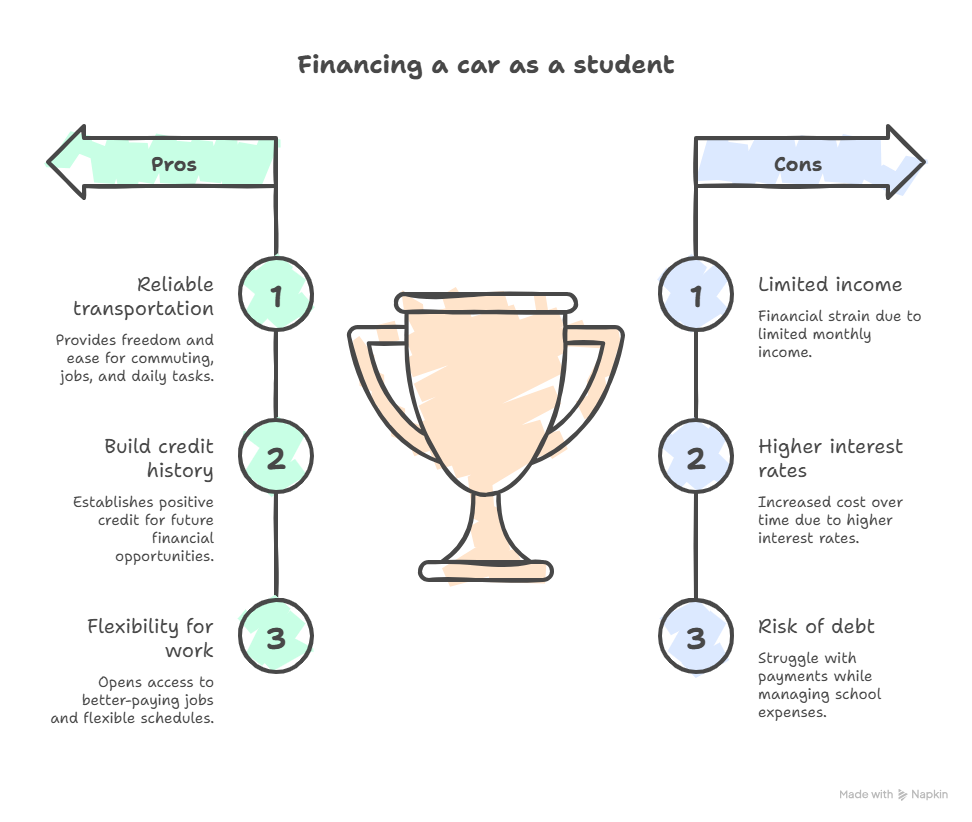
Access to reliable transportation
For many students, a car provides a level of freedom that public transit cannot always offer. It can make commuting to school easier, help students reach part-time jobs, and simplify everyday responsibilities like groceries, appointments, and travel.
Ability to build credit history
Making consistent, on-time car payments can help students build a positive credit history. Establishing credit early can be beneficial later in life when applying for credit cards, rental agreements, mortgages, or other loans.
More flexibility for work and school
Reliable transportation can open up more job opportunities and make it easier to balance school with employment. Students who can travel farther for work may have access to better-paying positions or more flexible schedules.
Challenges
Limited income
Many students are balancing coursework with part-time work, which can mean limited monthly income. Taking on a car payment without a stable budget can create financial strain.
Higher interest rates for thin credit
Students who are just beginning to build credit may be offered higher interest rates than borrowers with established credit histories. This can increase the overall cost of the vehicle over time.
Risk of taking on too much debt
While a vehicle can be helpful, it’s still a financial obligation. Students who borrow more than they can comfortably afford may find themselves struggling with payments while managing other school expenses.
By weighing these pros and cons carefully, students can decide whether financing a car is the right move for their current financial situation.
9. Key Takeaway: Can a Student Finance a Car in Canada?
So, can a student finance a car in Canada? The answer is yes—but approval depends on a few important factors.
Students across Canada successfully finance vehicles every year. However, lenders still evaluate the same financial fundamentals they would for any borrower. This means that income, credit history, and the type of lender you apply with play a major role in whether your application is approved.
Students who already have steady income and some credit history may qualify through traditional lenders like banks or credit unions. But even students with little or no credit history still have options. Many dealership lenders, auto finance brokers, and online lending platforms specialize in helping first-time borrowers get approved.
There are also ways students can improve their chances of securing financing. For example, adding a cosigner with stronger credit or providing a down payment can reduce the lender’s risk and increase the likelihood of approval.
International students may also be able to finance a car in Canada, although they often face stricter requirements, such as providing proof of legal status, employment, and ensuring the loan term does not extend beyond their study permit.
At the end of the day, lenders focus on one key question: Can the borrower realistically repay the loan? Students who can demonstrate stable income, responsible financial habits, and proper documentation often have a solid chance of getting approved for car financing in Canada.
10. Sources and References
The information in this article is based on research and guidance from reputable Canadian auto finance resources and lending institutions.
Loans Canada — Car Loans for Students
https://loanscanada.ca/auto/car-loans-for-students/Canada Drives — Vehicle Financing and Auto Financing Resources
https://www.canadadrives.ca/vehicle-financing
https://www.canadadrives.ca/auto-financingScotiabank — Graduate Auto Loan Program
https://www.scotiabank.com/ca/en/personal/loans-lines/grad-auto-loan.htmlHayden Agencies — Student Car Loans in Canada
https://haydenagencies.com/im-a-student-so-how-can-i-get-a-car-loan-in-canada/Autorama — Can I Use My Student Loan to Buy a Car?
https://www.autorama.ca/finance-articles/can-i-use-my-student-loan-to-buy-a-car/Carpages — Car Financing Guidance
https://www.carpages.ca/ShunStudent — Financing a Car as an International Student
https://shunstudent.com/
Frequently Asked Questions (FAQ)
Can a student really finance a car in Canada?
Yes, students can finance a car in Canada. Approval usually depends on factors such as income, credit history, residency status, and the lender you apply with. Students who have steady income or a cosigner often have a higher chance of getting approved.
What credit score does a student need to finance a car in Canada?
There is no exact minimum credit score required. Some students qualify with limited or newly established credit, especially through dealership lenders or online auto financing platforms. However, having a higher credit score can help secure better interest rates.
Can a student get a car loan without a cosigner?
Yes, it is possible for a student to get approved without a cosigner if they have stable income, some credit history, or a down payment. However, many students use a cosigner, such as a parent or family member, to improve approval chances and potentially get better loan terms.
Can international students finance a car in Canada?
International students may be able to finance a car, but the requirements are often stricter. Many lenders require a valid study permit, driver’s license, Social Insurance Number (SIN), and proof of employment. Some lenders also require that the loan term does not extend beyond the duration of the student’s permit.
Is getting pre-approved for a car loan a good idea for students?
Yes, getting pre-approved can be very helpful. Pre-approval allows students to see how much they may qualify to finance, estimate monthly payments, and understand their budget before visiting a dealership. This can make the car-buying process easier and help avoid applying for vehicles that may be outside their financing range.
